
Pronouncing YHWH Correctly
This article, originally in three-parts, has been viewed over 14,300 times by people on this site and other sites.
Part I – Spelling and Pronunciation
Using the Greek or English Vowels of Revelation
One suggestion is that we are to use the vowels in the I AM (or perhaps the Alpha Omega) of Revelation to spell the name, thus insisting that Yahovah is the correct spelling. Well, “I AM” in Greek is ego eimi. By that reckoning, the name would be spelled Yehoweihi. Or perhaps, referring to the Alpha and Omega, it would be spelled Yahawoeha or Yahawohea. If we used the English vowels, then it would become Yihwah. That manner of thinking is not even close to correct.
Bluntly put, we do not spell Hebrew words according to Greek or English word spellings.
David Bivin of Jerusalem Perspective puts it this way: “In any attempt to understand the Bible, there is no substitute for a knowledge of ancient Jewish custom and practice. For example, the term ‘Jehovah,’ which is found in many Christian translations of the Bible, originated due to Christian lack of awareness of Jewish custom.” He further states: “By linguistic comparisons with other ancient Semitic languages, scholars can be almost certain that the divine name was originally pronounced YaHWeH.”
The pronunciation of the first syllable of the tetragrammaton is confirmed by the abbreviated form of YHWH’s name Yah, which is sometimes used in Biblical poetry and other verses over forty times (see Exodus 15:2; Psalm 68:4, etc.). It is also confirmed by the yah that is attached as a suffix to many Hebrew names such as ‘eliyah (Elijah) and ‘ovadyah (Obadiah).
There Was No Vav In The Ancient Hebrew
When the ancients wanted a ‘v’ sound, they would use the Bet/Vet, the second letter of their alphabet, not the sixth letter. Ancient Hebrew did (and still does) indeed have a letter ‘W’, the sixth letter of the Hebrew Alphabet, originally pronounced waw. Hence, if you said the letters of Elohim’s name in Ancient Hebrew, it would be “Yod-Hey-Waw-Hey” (YHWH). The name YHWH appears 6,829 times in the Hebrew Scriptures. Only if you are using a modern mispronunciation would you say “Yod-Hey-Vav-Hey” (YHVH).
Jews that primarily speak Arabic have the same letter in Arabic which they pronounce like the English word wow. In Hebrew it becomes waw, pronounced very similarly. Hello! Hebrew and Arabic come from the same root – they both stem from Abraham and his sons – Isaac and Ishmael, who all spoke the same language! This fact should not ever be dismissed, as many are wont to do.
The Change From the Waw to Vav and the Yah to Jah or Jeh
According to Nehemiah Gordon of the Berean Patriot, when scholars went around the Jewish world in the 1800’s they documented how the Jews of that time pronounced every letter of the Hebrew alphabet. Aleph, Bet, Gimel, Dalet, Hey; all of those were identical, no matter what nation the Jews were living in. But not the waw.
I believe this is how the waw of Ancient Hebrew became the modern vav: As the Jews were scattered abroad, they came in contact with people who spoke Germanic languages, and as we all know very well, not only do they say ‘Y’ as Jah, they also say ‘W’ as Vah. As time went on the mingling of languages became more embedded.
The Change to Yahovah / Yehovah (and/or Jahovah / Jehovah)
Exodus 20:7, Deuteronomy 5:11 – “You shall not take the name of YHWH your Elohim in vain.”
This commandment soon became taken to mean that one should not use the sacred name frivolously or irreverently, rather than as a name by which one swore an oath, and simply was not used in conversation to avoid the risk of violating the commandment. Instead, words such as Ha’Shem (The Name H8034 שֵׁם) or Adonai (H136 אֲדֹנָי) were used. Even though the pronunciation of YHWH was likely still known to all when Yeshua arrived in Jerusalem, to avoid uttering it, other words were virtually always substituted.
A system of vowel signs that had been developed by the Masoretes in the 6th Century AD placed the vowel signs of the word Adonai into the consonants YHWH. The Masoretes had also altered the “ah” vowel of the first syllable so that readers would not see “Yah” and inadvertently blurt out the unutterable name, thus violating the commandment. Early Christian scholars in Europe also misunderstood this command and not realizing the alterations made by the Masoretes then presented the spelling Jehovah. Those who noticed the over forty uses of Yah in the scriptures and the ending of many Hebrew names continued to use the spelling: Jahovah.
New spellings for YHWH such as Jahovah or Jehovah should not be created out of our ignorance of Jewish conventions. Neither Jahovah nor Jehovah have any meaning in Hebrew! The Jahovah and Jehovah misspellings simply and vividly illustrate a continuing lack of understanding of Hebrew language and Jewish practice.
The Ancient Hebrew Research Center Possibilities
Researchers at the Ancient Hebrew Research Center say it is entirely possible that the name Yod-Hey-Waw-Hey may have different vowels. A tiny sample of some of those possible spellings, are:
• YaH-WeH
• YiH-WeH
• YeH-WaH
º Ye-Ha-WaH
º Ye-He-WeH
º Ye-Ho-WaH
As you can see, the last three examples follow the imposition of other word’s vowels into the YHWH.
The researchers do ask an important question, however. They ask: “When we are teaching Yahweh to others, are we placing the importance on the pronunciation of that name, or are we teaching them the character of Yod-Hey-Waw-Hey? . . . When someone insists on a particular pronunciation, even to the point of making it a Salvation issue, is that person creating unity – or chaos?”
The Encyclopedia Comments
Charles H. Campbell of AlwaysBeReady has compiled a list of commentaries by various encyclopedias. The encyclopedias state:
• The Jewish Encyclopedia: “Jehovah — a mispronunciation of the Hebrew YHWH the name of God.”
• The New Jewish Encyclopedia: “It is clear that the word Jehovah is an artificial composite.”
• Encyclopedia Judaica: “the true pronunciation of the Tetragrammaton YHWH was never lost. The name was pronounced Yahweh.”
• The Universal Jewish Encyclopedia: “JEHOVAH is an erroneous pronunciation of the Tetragrammaton.”
• Encyclopedia Americana: “Jehovah — erroneous form of the name of the God of Israel.”
• Encyclopedia Britannica: “The pronunciation ‘Jehovah’ is an error resulting among Christians from combining the consonants YHWH with the vowels of ADHONAY.”
• Webster’s Collegiate Dictionary: “Jehovah — False reading of the Hebrew YAHWEH.”
• Webster’s Third New International Dictionary: “Jehovah — Intended as a transliteration of Hebrew YAHWEH, the vowel points of Hebrew ADHONAY (my lord) being erroneously substituted for those of YAHWEH.”
• New Catholic Encyclopedia: “Jehovah — false form of the divine name YAHWEH.”
• The New Schaff-Herzog Encyclopedia: “Jehovah — is an erroneous form of the divine name of the covenant God Israel.”
Neither Jahovah nor Jehovah are appropriate spellings of YHWH.
Why I Believe The Waw / Yod Were Changed
We know that Satan hates humans, and especially Yeshua. Why have the Waw (the sixth letter) and the Yod (the tenth letter) both been attacked and perverted? The Waw represents man/mankind, and the Yod represents Yeshua. Satan wants to destroy both, and trumpets it by rejecting the original pronunciation and introducing an alternative way to spell and speak both Hebrew letters.
Parts II and III – Spelling and Archaeology
2 Kings 21:4 – “He built altars in the house of Yahweh, of which Yahweh had said, ‘In Jerusalem will I put my name’.”
2 Kings 21:7 – “In Jerusalem, which I have chosen out of all the tribes of Israel, I will put my name forever.”
Recent archaeology discoveries have confirmed that the original spelling of the tetragrammaton is YHWH in the ancient Hebrew text. Two such discoveries are highlighted in the Expedition Bible videos below.
The first discovery comes from Soleb, in Egypt, during the 15th Century BC. The Pharaoh of that time inscribed the names of his enemies into the walls of a temple and mentions the name of Yahweh, the Israelite god. Egyptologist Donald Redford documented this find in his 1992 book: Egypt, Canaan, and Israel in Ancient Times.
A picture of this hieroglyph with descriptions and the video are below:

The second discovery comes from a burial site in Katef Hinnom, a suburb of Jerusalem, by Dr. Gabriel Barkay in 1979. It is the oldest copy ever found of a portion of a verse taken from the book of Numbers 6:24-26 in the Hebrew Bible, from around 7BC, the time of the first temple of Solomon.
Other recent archaeology discoveries have confirmed that the original pronunciation of the tetragrammaton in the ancient Hebrew text is Yahweh, and the spelling is YHWH. Here is a third discovery found on an early Israelite curse inscription from Mt. Ebal that confirms this.
The Folded Lead Tablet
In March 2022, a lead tablet from Mt. Ebal was discovered by a research team led by scholars from the Associates for Biblical Research. At that time they claimed that it contained one of the oldest extant Hebrew inscriptions. Now, after more than a year, one part of the inscription has been peer-reviewed and published in the Heritage Science journal.
The The Folded Lead Tablet , containing writing on both its inside and outside, measures less than one square inch and appears to have been folded in half after being written.
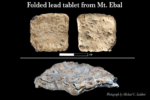
The Inscription
As translated by the Associates for Biblical Research (ABR) team, the tablet reads:
• You are cursed by the god yhw, cursed.
• You will die, cursed—cursed, you will surely die.
• Cursed you are by yhw—cursed.
The team suggests that “the use of the name Yhw, a shortened version of the divine name Yahweh (YHWH), is clear evidence that the text is an early Hebrew inscription.”
The Objections
Aren Maeir, Professor Of Archaeology at Bar-Ilan University, says: “The object and its context are problematic; the data presented is of a very poor or even misleading character; the understanding of the archaeological context and its dating is lacking; the suggested reading is very hard to accept; and the generalizations and conclusions brought forward by the authors seem to be totally baseless.”
Christopher Rollston, a noted epigrapher from George Washington University said: “Facts are facts, and this article is very short on facts and very long on boundless speculation.”
The Rebuttals
In response to this criticism, Pieter van der Veen, a team epigrapher and Professor at Johannes Gutenberg-Universität Mainz, stated, “I have worked with lead. I can assure you, what we see are NOT mere striations. Rather what we see is man-made and incised with a pen or stylus. The bulges seen on the back of the tablet prove that those letters are true letters indeed. They precisely match the signs on [the inside] and must be incisions to be actually visible on the back. These are not simple scratches or damage.”
ABR’s Director of Excavations, Scott Stripling similarly defended the team’s reading of the text, saying, “As several interior letters can also be detected on the outside of the tablet, where pressure marks of these letters caused by the stylus appear, we can be certain that they are there and that in most cases, the incisions are undoubtedly man-made.”
Conclusions
1) The original spelling of the name was Yod-Hey-Waw-Hey.
2) The original pronunciation of the sixth letter was “waw” and still is when correctly pronounced.
3) Ancient Hebrew had and still has a ‘V’ sound – the Bet/Vet, but the name is not spelled Yod-Hey-Bet/Vet-Hey.
4) We don’t use Greek or English spelling to determine Hebrew spelling.
5) We don’t substitute other Hebrew word vowels into the YHWH to come up with the spelling.
6) Archaeology clearly shows that YHWH is the correct spelling of the tetragrammaton.
7) Archaeology clearly shows that Yahweh is the correct pronunciation of the tetragrammaton.
8) YHWH’s name is not Yahovah/Jahovah. That word (and the alternate Yehovah/Jehovah) is a colossal, undeniable, erroneous mistake. Therefore, I will continue to use Yahweh in my writing and speaking.
9) Satan has rejected the pronunciation of the sixth and tenth letters due to his hatred of Yeshua and mankind, has introduced an alternative, and many have chosen this perverted way to speak and write the Yod and Waw.
The name, however one spells it or pronounces it, seems to be a moot point. Yeshua is the YHWH of the Older Covenant, and he commands us to pray to our Heavenly Father in his name – in the name of Yeshua (John 14:13; 15:16; 16:23-26, etc.).
If the Older Covenant pronunciation were so important or necessary, Yahweh would have made sure it was retained, just as he has made sure his entire word has been preserved, and Yeshua would have taught his disciples how to properly speak and spell it, but he did not do so – he followed Jewish tradition and also substituted other words in place of the YHWH.
Since Yeshua is YHWH of the Older Covenant, and we know how to speak and spell his name, perhaps he did teach both his disciples and us how to properly speak and write God’s name, eh?
Final Thought for 2026
• The season of the birth pains is here – keep maintaining an attitude of gratitude.
• The prophetic signs continue to unfold in an escalating pattern as foretold by the Hebrew prophets.
• History is moving extremely quickly towards the one world government, financial system, and religion.
• Time is incredibly short – Yeshua Ha’Mashiach is coming soon – so be of great cheer and keep looking up.
• Be sure you are believing The Truth, not The Lie – get busy reaching the lost.
• Be sure Yeshua is your Redeemer, King, and High Priest, and your sins are forgiven.
Related Links
Ancient Mention of Yahweh = https://youtu.be/pGEOZ5YI22M
Oldest Bible Verses Found = https://youtu.be/X74dr58e6T8
Biblical Archaeology.org Article
Folded Lead Tablet Picture
Originally posted June to August 2023
 Rapture Parallels, Patterns, Pictures, and Types