Scripture gives us many parallels, patterns, pictures, and types, examples, or shadows of Yeshua’s cross. Below are several:
The Blood on the Door
Exodus 12:7 – “You shall take some of the blood of the Lamb and put it on the two door posts and the lintel of the houses in which they eat it.”
Exodus 12:22 – “Take a bunch of hyssop, dip it in the blood that is in the basin, and touch the lintel and the two door posts with the blood in the basin.”
The Lintel is the horizontal crosspiece over an opening such as a door, or window, usually carrying the weight of the structure above it. The door posts are the two frames on either side of the door. The blood of the spotless sacrifice was taken from the basin on the ground and put on the lintel and on the door posts of their homes so that the destroyer of the firstborn would not touch the firstborn of Israel. This foreshadowed the blood of Yeshua Ha’Mashiach, the Lamb of God, who gave his blood for the sins of all people. Thus, without realizing it, the Egyptian Hebrews were making the sign the cross itself in this act. Hence, a Shadow of Yeshua’s Cross!
Moses and His Hands
Exodus 17:12 – “But Moses’ hands grew weary; so they took a stone and put it under him, and he sat on it. Aaron and Hur held up his hands, one on one side, and the other on the other side; so his hands were steady until the sun.” The position of Moses, with both hands out, becomes a cross. Hence, a Shadow of Yeshua’s Cross!
The Tabernacle Set-up
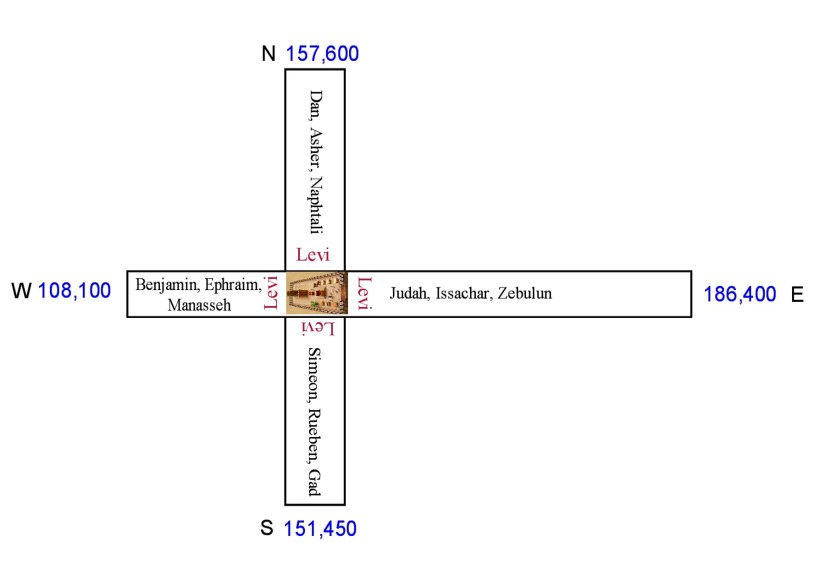
Numbers 3:23-38 – The groupings of the tribes around the Tabernacle form a cross. Hence, a Shadow of Yeshua’s Cross!
The Altar of Sacrifice
Exodus 29:12 – “You shall take some of the blood of the bull and put it on the horns of the altar.”
The Altar of Sacrifice is, of course, the place where the sacrifice for sin takes place (Exodus 27:1-8). Animal sacrifices were offered on this altar, located in the court in front of the tabernacle. The blood of the sacrifice was sprinkled on the four horns of the altar (Exodus 29:12 and 30:10, Leviticus 4:7-34, Ezekiel 43:20), which symbolize the four points of the cross that were covered with Yeshua’s blood: At the head from the crown of thorns, and at the feet and the two arms (hands), from the puncture wounds of the nails that held him to the cross. Hence, a Shadow of Yeshua’s Cross!
The Anointing of Aaron and His Sons
Exodus 29:20-21, Leviticus 8:23-24 – “And you shall take some of its blood and put it on the lobe of Aaron’s right ear and on the lobes of the right ears of his sons, and on the thumbs of their right hands, and on the big toes of their right feet.”
Note the four points of blood: the head, the hands, the feet. Hence, a Shadow of Yeshua’s Cross!
The Bronze Serpent
Numbers 21:8-9 – “And the LORD said to Moses, “Make a poisonous serpent, and set it on a pole; and everyone who is bitten shall look at it and live.”
John 3:14-15 – “And just as Moses lifted up the serpent in the wilderness, so must the Son of Man be lifted up, that whoever believes in him may have eternal life.”
Moses made a serpent of bronze, put it upon a pole, and whenever a serpent bit someone, that person would look at the serpent of bronze and live. All who looked upon the image would be healed by faith. So, too, do we look at a cross and see Yeshua for healing and salvation. Israel later perverted the sign into an object of worship (2 Kings 18:4), and it is important that we do not make our cross into an idol, but look to Yeshua. Hence, a Shadow of Yeshua’s Cross!
The Hanging Tree
Deuteronomy 21:22 – “If someone has committed a capital crime and is put to death, then hung on a tree . . .”
A traditional cross was rarely two wooden posts nailed together, as shown in most churches today, but was most often an olive tree upon which a crossbeam was attached, as required by Deuteronomy 21:22. The person hanging from the tree would be in the shape of a “T”, or in Hebrew, the shape of a tav. The tav was written was in the shape of a lower case “t” (or plus sign) in ancient Hebrew. Today the tav is often written in the shape of an upper case “T”. Hence, a Shadow of Yeshua’s Cross!
The Marks of God
Genesis 4:15 – “And the LORD put a mark on Cain, so that no one who came upon him would kill him.”
Ezekiel 9:4-6 – “Go through the city, through Jerusalem, and put a mark on the foreheads of those who sigh and groan over all the abominations that are committed in it.”
Scripture does not directly tell us what these marks were, but in the Ezekiel passage above, the word translated mark is the Hebrew word tav [H8420]. Since the sign of the cross throughout scripture symbolizes salvation, healing, and redemption, we can safely presume that this mark takes the shape of a cross. Perhaps the mark on Cain, an ‘owth [H226] in Hebrew, was also a tav. Hence, Shadows of Yeshua’s Cross!
The Seal of God
Revelation 7:3-4 – “Hurt not the earth, neither the sea, nor the trees, till we have sealed the servants of our God in their foreheads. And I heard the number of those who were sealed, one hundred and forty-four thousand sealed from every tribe of the sons of Israel.”
Revelation 9:4 – “The locusts were told not to damage the grass of the earth or any green growth or any tree, but only those people who do not have the seal of God on their foreheads.”
The word translated sealed is the Greek word sphragizo [G4972], which means to mark. The word translated seal is similar, sphragis [G4973] in Greek. In Hebrew both would be the word tav [H8420]. The tav denotes a mark, sign, or cross, and in ancient Rabbinical tradition the Tav is known as the Seal of God and also the Seal of Truth. Again, scripture does not directly tell us what shape these seals will be, but it will not surprise me if these, too, are in the shape of a cross. Hence, Shadows of Yeshua’s Cross!
Yeshua’s Cross
1 Peter 1:18-19 – “You know that you were ransomed from the futile ways inherited from your ancestors, not with perishable things like silver or gold, but with the precious blood of Christ, like that of a lamb without defect or blemish.”
Externally, it was the actual blood that saved them from the death angel. Internally, this substitution was appropriated through obedient, humble, submissive faith. The Feast of the Passover is an annual holiday in honor of the night when the Lord passed over the homes of the Israelites. The Hebrews followed God’s instructions by placing the blood of a lamb on the lintel and door posts. That night the firstborn son of every family who did not have blood on the door posts was killed. The lamb had to be killed in order to get the blood that would protect them. Inside their homes, the Israelites ate a meal of roast lamb, bitter herbs, and bread made without yeast. Unleavened bread could be made quickly because the dough did not have to rise, and also symbolizes the sinless nature of Yeshua. Bitter herbs signified the bitterness of slavery. Now, the Lords Supper is our Passover remembrance of our new life and freedom from sin. The next time struggles and trials come, remember how God has delivered you in the past and focus on his promise of new life with him.
Conclusions
• Patterns in the shape of the Hebrew letter tav, a “+”, a “t”, or a “T”, are found throughout scripture.
• Patterns in the shape of the cross are found throughout scripture.
• All are shadows of Yeshua’s Cross.
Final Thought for 2023
The stage for Yeshua’s return is being set. Prophecy continues to unfold in an escalating pattern as foretold by the Hebrew prophets. The season of the birth pains is here – they are burgeoning and not going away. Time is short – Yeshua Ha’Mashiach is coming soon – be sure you have salvation in Yeshua and keep busy reaching the lost.
NOTE: Originally posted in April 2012, Titled: Shadows of the Cross
 Rapture Parallels, Patterns, Pictures, and Types